

Everybody in AI seems to be talking about Jev AI right now. TypeSafe AI released Jev on September 15, 2026, positioning it as a new kind of System One Model built for fast decisions rather than text generation. The launch quickly sparked discussion around decision models, open-source Jev ai alternatives, and whether generative LLMs are doing work they were never designed to do efficiently.
And that leads to a bigger question.
We have been using LLMs like a hammer for almost every AI problem—even simple decisions.
Should this support ticket go to billing or engineering? Which model should handle this request? Is this tool call risky? Does this retrieved passage actually answer the question?
A general-purpose LLM can make all of these judgments. But when the application only needs one answer from a known set of choices, generating tokens and parsing the response can be more machinery than the task requires.
Jev takes a different approach. Give it the current state and predefined questions, and it returns typed decisions with probabilities rather than generated prose. TypeSafe reports 20–200× faster and 40–400× cheaper performance in its evaluated workflows, with pricing of $0.042 per million input tokens and no output-token charge.
The trade-off is just as important: Jev cannot generate text. It is built to decide, not write.
That limitation has already opened the door to several Jev AI alternatives. Projects such as Laya, SemIf/OpenJev, mini-jev, Bespoke Nimble, Kev, and jevlike are exploring open, local, and self-hosted ways to make Jev-style decisions.
Knolli approaches the problem from another layer. Instead of treating classification as the final result, Knolli can classify a request on the fly and use that intent to route work through the appropriate model, specialized agent, business knowledge, and workflow.
So the interesting question is no longer just “What can replace Jev?”
It is “Do you only need the AI to make a decision—or do you need that decision to turn into useful work?”
Jev AI is built for frequent, bounded decisions where the possible answers are already known but ordinary code cannot easily understand the meaning of the input. Instead of asking an LLM to generate and format a response, Jev AI returns a decision your application can act on.
The best Jev AI use cases have three things in common: a human could make the judgment quickly, the possible outcomes can be defined beforehand, and the decision happens often enough for latency and cost to matter.
The common thread is simple: Jev AI works when your software already knows the possible actions but needs AI to understand which action best matches the current situation.
Also read What Is Jev AI?
It does not replace the surrounding application logic. The model supplies the fuzzy semantic judgment; your code still decides what happens next.
Jev AI and a large language model can both look at a support ticket and decide that it belongs to billing. The difference is how they arrive at that answer and what they return to the application.
A generative LLM is built to predict and generate tokens. Even when you constrain the output to JSON or a single category, the underlying system is still a generative model. Jev AI is designed around the decision itself: the developer defines the possible outcomes, and Jev AI returns a typed answer with probabilities.
Structured output already solves an important LLM problem. You can ask models from OpenAI, Anthropic, Gemini and others to return information according to a predefined schema instead of unpredictable prose.
But the model underneath is still generative.
Suppose your application needs to route a request to one of three teams:
Billing | Engineering | Sales
A structured LLM can generate something like:
{
"department": "billing"
}
Jev AI approaches the same problem as a bounded decision. The three possible outcomes are declared beforehand, and the response can include a probability for each:
{
"billing": 0.91,
"engineering": 0.07,
"sales": 0.02
}
There is no fourth department for Jev AI to invent and no free-form paragraph for the application to interpret.
That does not mean Jev AI will always select the correct department. It means its output stays inside the answer space the developer defined.
The winning answer is only part of the decision. The probability distribution tells your application how certain that decision appears to be.
Consider a different result:
Billing technically wins, but automatically routing the request based on that narrow margin may be a bad idea.
Instead, developers can put the threshold in code:
TypeSafe calls its training approach Reinforcement Learning for Calibrated Decisions (RLCD). The goal is not merely to return a probability, but for that probability to correspond meaningfully with accuracy across many predictions.
This is the core difference: LLMs are built to generate. Jev AI is built to decide.
Neither interface is automatically better. The useful question is whether your application needs an answer it can show to a person or a decision it can hand directly to software.
Jev AI fits around the generative model rather than replacing it. The LLM can plan, write, reason, and use tools. Jev AI can handle the smaller decisions around that work: where a request should go, whether an action looks risky, or whether a result is good enough to continue.
A simplified agent flow can look like this:
User Request → Classification/Decision → LLM or Agent → Tool → Verification → Action
Jev AI can sit at several points in that flow.
Using the most capable model for every request is unnecessary when many requests are simple. Jev AI can inspect the request and decide which model should receive it.
For example:
Jev AI does not answer the original request in this setup. It decides which model should.
This becomes more useful as an application uses multiple models with different costs, latency profiles, and capabilities.
Agents become more useful when they can take actions, but actions also introduce risk.
Reading a file is different from deleting one. Checking Git status is different from rewriting history. Querying a production database is different from modifying it.
Jev AI can evaluate those semantic differences before a tool runs. An application might classify an action as:
Read-only → Reversible → Destructive
Separate decisions can also check whether the action touches production, deletes data, modifies permissions, or should require human approval.
The application still owns the safety policy. Jev AI supplies the semantic judgment; code decides what that judgment is allowed to trigger.
Agents also need decisions after they act.
An LLM may say a task is complete even though the result still violates a requirement. Jev AI can inspect the resulting state and answer bounded questions such as:
Jev AI should not replace deterministic verification when software can check something exactly. If a test suite can tell you whether the code passes, run the tests. A semantic decision model is more useful when meaning, rather than a hard condition, determines whether the result is acceptable.
This is also where Knolli and Jev AI start to look related without being the same kind of product.
Jev AI can make a bounded routing decision inside an agent. Knolli approaches routing from the broader application layer. It can classify a request on the fly and connect that intent to the appropriate model, specialized agent, business knowledge, and workflow.
The flow becomes:
The distinction is useful:
Jev AI helps software decide. Knolli can use classification to decide how the broader AI workflow should proceed.
For a business building an AI copilot, classification is often not the final output. It is the mechanism that gets the request to the right expertise so the actual work can begin.
Jev AI works best when the possible answers are known in advance and the model only needs to decide which one applies. If the task requires open-ended generation, exact computation, or deeper reasoning, Jev AI is usually not the model you want.
Here are the main cases where Jev AI is a poor fit:
There is also an important distinction between valid output and correct judgment.
If you give Jev AI three possible answers - billing, technical, and sales - it cannot invent a fourth department. But it can still choose billing when the technique is correct.
So saying “Jev AI cannot hallucinate” needs context. A more precise way to put it is:
Jev AI cannot return an answer outside the declared output space, but it can still make the wrong decision within that space.
That is why confidence thresholds, deterministic checks, stronger-model escalation, and human review still matter.
The Jev ai alternatives appearing today are not all trying to solve the problem in the same way.
Projects such as Laya, SemIf/OpenJev, mini-jev, Bespoke Nimble, Kev, and jevlike try to reproduce parts of Jev's decision-first approach using open models, local inference, new scoring architectures, or different decoding methods.
Knolli takes another route. It treats classification as the beginning of a larger AI workflow rather than the final output.
That creates two useful categories:
Most direct Jev ai alternatives ask a technical question: can we reproduce fast, typed AI decisions with an open or locally hosted model?
Knolli asks a different question:
What needs to happen after the classification?
A business rarely needs finance, sales, or support as the final answer. Once the intent is understood, the request still needs to reach the right expertise. The system may need to select a model, retrieve company knowledge, call a specialized agent, or continue into another workflow.
Knolli uses on-the-fly classification as part of that larger AI copilot architecture.
The flow looks more like:
User Request → On-the-Fly Classification → Right Expertise → Model/Agent → Business Knowledge → Workflow → Action
Take a CFO asking:
“Why did our gross margin drop this quarter?”
A decision model could classify the request as financial_analysis.
Useful—but the work is not finished.
The application still needs to determine what financial expertise is required, which model should handle the analysis, what company information should be considered, and what output or action the CFO actually needs.
Knolli is designed around that broader execution path.
It can act as an orchestration layer across frontier-model providers such as OpenAI, Anthropic, and Gemini, allowing the underlying model to be selected around the task, capability, cost, privacy, and security requirements.
Classification can then connect the request to specialized expertise and relevant business knowledge before continuing through the appropriate workflow.
This distinction is easier to see side by side:
The distinction is not that Knolli reproduces Jev's RLCD architecture. It does not need to.
The two approaches sit at different layers:
Jev:State → Decision → Probability → Code
Knolli:Request → Classification → Model/Agent → Knowledge → Workflow → Action
That makes Knolli relevant when the reason you are researching Jev is classification and routing inside a larger AI application, rather than the need for a standalone decision model.
If the decision itself is what you need, Laya is one of the more direct open alternatives to Jev.
Laya is designed around typed decisions rather than free-form text generation. Its published model family supports the same broad decision shapes associated with Jev: Choice for selecting between predefined possibilities, Score for ordered evaluation, and Noul-style Boolean decisions.
The English checkpoint uses a 421M-parameter ModernBERT-large backbone, making Laya interesting for teams that want to run decision workloads on infrastructure they control.
That can be useful when local inference, offline operation, privacy, data residency, inspectable weights, or model specialization matter more than consuming a managed API.
The trade-off is responsibility.
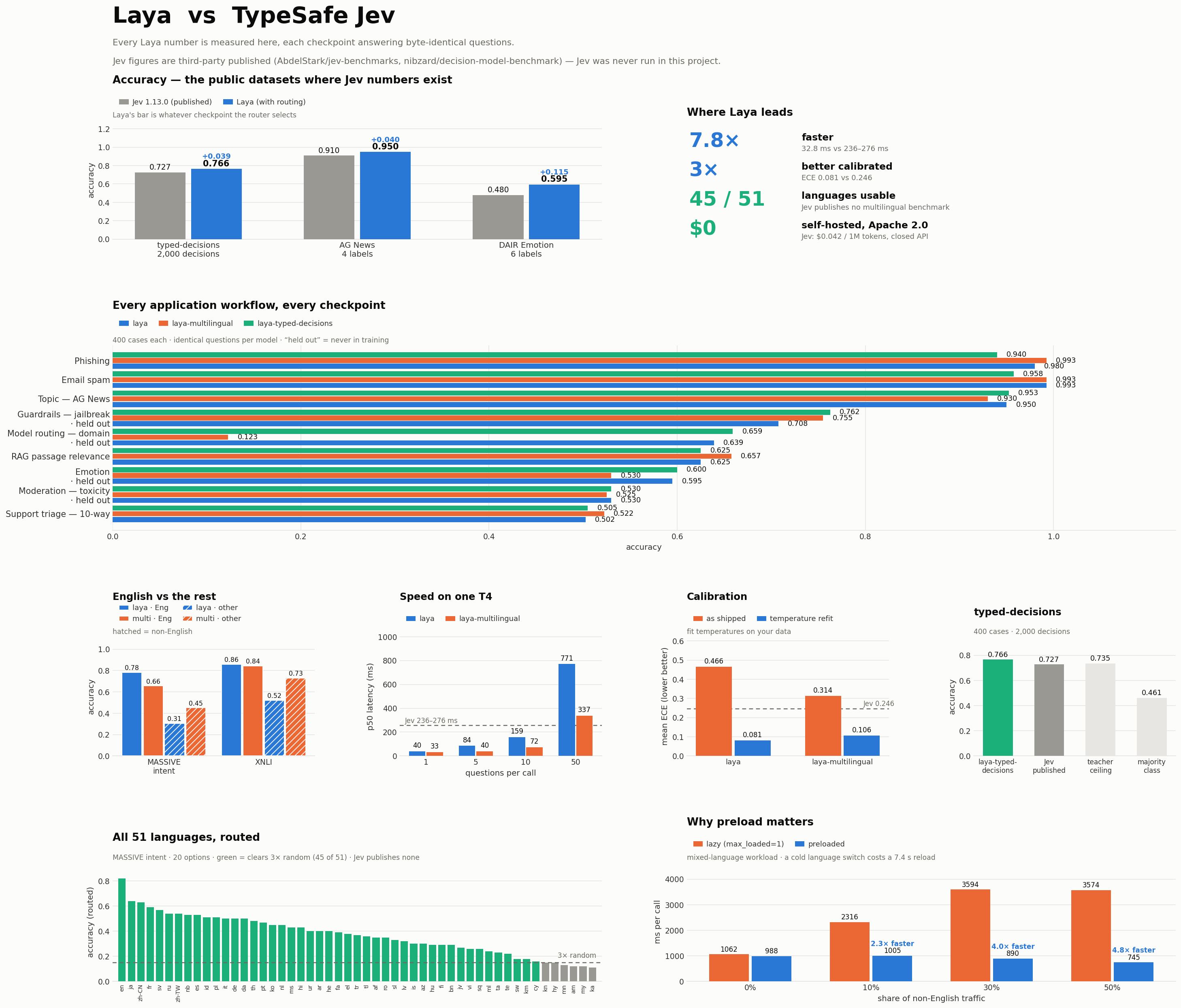
Published results show an important gap between Laya's base zero-shot behavior and its fine-tuned performance. That suggests Laya is better viewed as an open decision model that teams can specialize for their workloads, rather than an automatic drop-in replacement for Jev.
You also own more of the stack: deployment, hardware, monitoring, evaluation, fine-tuning, and potentially calibration.
SemIf/OpenJev takes a different approach again.
Instead of attempting to recreate TypeSafe's undisclosed RLCD training process, the project reproduces part of the decision-interface pattern using open language models.
The OpenJev approach uses candidate probabilities from Qwen-based models rather than asking the model to generate an entire prose or JSON answer.
That can give developers:
The important word there is signals.
A softmax probability can tell you that the model prefers option A over options B and C. It does not automatically prove that a prediction reported at 0.90 will be correct approximately 90% of the time.
So:
Probability output is not automatically calibrated probability.
That distinction matters when confidence thresholds determine whether software proceeds automatically or escalates a decision.
mini-jev strips the experiment down even further.
It uses a frozen Qwen model and reads the logits associated with candidate answers instead of asking the model to generate a structured response.
That makes it useful for testing a simple idea:
If the application only needs a decision, why generate the answer at all?
Its natural use cases include intent classification, routing, binary gating, local decision endpoints, and experiments with confidence signals.
mini-jev should still be treated as an experimental Jev-style implementation rather than an equivalent replacement for TypeSafe's model. Its option scores can rank possible answers, but that does not establish the same probability calibration claimed for Jev's RLCD approach.
Bespoke Nimble takes a more training-oriented route.
The project uses an open Qwen-based model with LoRA fine-tuning and synthetic contrastive training data to create a system focused on typed decisions.
This gives teams greater control over how the decision model itself is built.
That can be useful when the organization has a specialized classification problem and wants to train around its own decision patterns rather than rely entirely on a hosted general model.
The trade-off follows the same pattern as other open alternatives: more control creates more engineering responsibility.
The team becomes responsible for training choices, evaluation, serving, updates, infrastructure, and determining whether the resulting confidence signals are reliable enough for the intended workflow.
Kev explores another question: how small can a Jev-style decision model become?
Kev-0.5B uses Qwen2.5-0.5B with a LoRA adapter and decision/readout head, making it interesting for experiments involving smaller local models, limited hardware, and System One-style decision interfaces.
Its size makes local research more accessible.
But small size and API compatibility should not be confused with production equivalence.
A model can successfully demonstrate the decision architecture without matching the accuracy, calibration, reliability, or deployment maturity of a purpose-trained hosted system.
Kev is therefore most interesting as a local research and experimentation option.
jevlike moves further away from the idea of adapting a normal chatbot.
It uses a dedicated scoring architecture that evaluates candidate options against the supplied context and converts those scores into probabilities.
That makes it closer to a task-specific classifier than a zero-shot Jev replacement.
The approach becomes attractive when you have a relatively stable decision workload and training data for that problem.
The trade-off is flexibility. Jev is designed around decisions whose criteria can be supplied at runtime. A trained option scorer becomes more closely tied to the workload it learned.
The newest experiments attack the problem at the inference layer rather than simply training another classifier.
DiffusionGemma-based work and parallel constrained-decoding approaches explore whether structured decisions can be evaluated in parallel over constrained answer spaces rather than generated sequentially.
That raises an interesting possibility.
Maybe the choice is not always:
generative LLM vs dedicated decision model.
A third path may be to keep an existing model backbone but change how the structured decision is computed.
These projects are still experimental. Some implementations discussed around Jev involve research repositories or unmerged inference-engine work rather than mature production services.
But they reinforce the larger idea Jev has brought into focus:
A machine-readable decision does not necessarily need to be generated like a sentence.
For teams choosing among these alternatives, the dividing line is fairly clear. If you need the decision itself, Jev-style open models such as Laya, SemIf, mini-jev, Nimble, Kev, or jevlike deserve evaluation. If classification is only the first step before models, agents, company knowledge, and workflows take over, Knolli addresses the broader application problem.
Jev gives developers a managed API for typed AI decisions. Open alternatives such as Laya, SemIf/OpenJev, mini-jev, Bespoke Nimble, Kev, and jevlike trade some of that convenience for greater control over the model, infrastructure, data, and training process.
The reason to choose one is not simply that it is open source. The real question is whether that control matters enough to justify owning more of the AI stack.
A self-hosted Jev ai alternative can keep inference within infrastructure your organization controls.
That matters when decisions involve proprietary code, financial information, internal documents, customer records, or other sensitive business context. It can also matter in offline or restricted environments where sending every decision to an external API is undesirable.
The trade-off is straightforward: Jev gives you an API; a local alternative gives you infrastructure to operate.
Open models give engineering teams more say over how the decision layer runs.
Depending on the project, teams can control:
Laya, for example, provides an open decision-model approach, while SemIf/OpenJev builds Jev-style decisions around open-model backbones. Bespoke Nimble exposes more of the training recipe itself.
These are different forms of control, so “open Jev ai alternative” should not be treated as one architecture.
Open alternatives become particularly interesting when the same decision happens repeatedly inside a narrow domain.
Imagine a financial workflow that repeatedly classifies transactions as:
Routine → Review → High Risk → Human Approval
A team with enough representative examples may want to specialize the decision model around those categories rather than depend entirely on a general hosted model.
This is where projects such as Laya, Nimble, Kev, and jevlike become interesting.
But specialization changes the economics. You may save API costs while taking on training, evaluation, serving, and maintenance costs.
If classification or routing sits in the middle of every AI request, it becomes an important infrastructure dependency.
Open weights provide another option. Teams can pin versions, test upgrades before deployment, and change the surrounding inference system without waiting for a hosted provider.
That does not automatically mean lower cost. At Jev's reported $0.042 per million input tokens, teams need substantial volume or another requirement—such as privacy, local inference, or customization—for self-hosting economics to become compelling.
Open implementations also make experimentation easier.
Developers can inspect candidate scoring, swap model backbones, test alternative prompts or criteria, change inference methods, and evaluate performance against their own labeled examples.
That visibility is particularly useful because several Jev ai alternatives take fundamentally different approaches.
SemIf/OpenJev and mini-jev read option probabilities from open language models.
Laya uses a dedicated decision-model architecture.
jevlike trains an option scorer.
Diffusion and parallel-decoding projects change how candidate decisions are computed during inference.
They may expose similar outputs while reaching them in very different ways.
This is one of the biggest technical caveats.
Suppose an open model returns:
billing: 0.90
That tells you the model strongly preferred billing relative to the other choices.
It does not automatically mean that predictions assigned 0.90 confidence will be correct approximately 90% of the time.
TypeSafe positions RLCD—Reinforcement Learning for Calibrated Decisions, as a core part of Jev's design. Community projects that read softmax probabilities or option logits do not automatically reproduce that property.
For production routing, gating, or approval workflows, teams should test confidence against their own labeled cases before allowing probability thresholds to trigger important actions.
Running your own model means taking responsibility for things a managed API normally handles:
So the decision is not simply Jev versus free open source.
It is managed decision intelligence versus greater ownership of the decision stack.
And there is a third possibility.
If your real requirement is not owning the decision model but using classification to route work across AI models, agents, company knowledge, and workflows, an orchestration tool such as Knolli solves a different problem than either Jev or its open-source clones.
Jev's headline numbers are difficult to ignore. TypeSafe reports that Jev can be 20–200× faster and 40–400× cheaper than comparable LLM-based decision workflows. The reason is architectural: Jev is designed to return bounded decisions rather than generate a response token by token.
The figures reported around Jev's launch include:
The output pricing needs context. Jev is not giving away conventional generated output tokens. Its architecture does not generate normal prose output in the first place.
A generative LLM produces tokens sequentially.
That is useful when the application needs a paragraph, explanation, code block, or other generated result. It creates unnecessary work when the useful answer is simply one of five known options.
The difference compounds inside an agent.
An application might repeatedly need to decide:
Which model? → Which tool? → Is this safe? → Is this relevant? → Is the task complete?
TypeSafe says Jev can evaluate independent questions about the same state in parallel rather than requiring a sequence of generated responses.
This is where the decision-first architecture can produce substantial latency and cost savings.
One demonstration shared around Jev's launch involved navigating between Wikipedia pages using only available links.
At each step, the system may need to choose between hundreds or thousands of valid links.
The application already knows what the possible actions are. It does not need the model to invent another link or explain the choice in prose.
It needs one judgment:
Which available option is most likely to move us toward the target?
This is the type of workload Jev is designed around.
This is where benchmark comparisons become harder.
The projects attempting to reproduce Jev-style behavior do not all use the same architecture, hardware, evaluation datasets, context lengths, or definition of confidence.
For example, Laya's published results distinguish sharply between its base zero-shot performance and fine-tuned checkpoints. SemIf/OpenJev and mini-jev instead derive decision signals from option probabilities in open language models. jevlike trains a dedicated option scorer.
Those numbers should not be placed in one table and treated as an apples-to-apples leaderboard unless they have been evaluated under the same conditions.
The same caution applies to latency.
A local model running on a high-end GPU may avoid network latency but introduce hardware costs. A tiny model may run quickly but provide weaker decision quality. A fine-tuned model may perform well on its target workload but lose the runtime flexibility that makes Jev interesting.
TypeSafe's headline figures come from its own workflow evaluations.
They should therefore be read as reported performance under specific comparisons, not as a guarantee that Jev will always be 200× faster or 400× cheaper than every LLM or open alternative.
The largest gains should naturally appear when the competing generative model is doing work Jev was specifically designed to remove: high-volume semantic decisions with predefined answer spaces and no need for generated prose.
If the workload needs deep reasoning, a detailed explanation, code generation, or a multi-step business workflow, the systems are no longer doing equivalent work.
That is the most useful way to read Jev's benchmark story:
Jev is fast because it specializes in a narrower job.
The right comparison is therefore not simply tokens per second. Teams should measure decision accuracy, calibration, end-to-end latency, infrastructure cost, escalation rate, and the cost of incorrect decisions on their own workload.
The right Jev ai alternative depends on what you are actually trying to replace.
If you want Jev-style typed decisions on infrastructure you control, look at the open decision-model projects. If your real requirement is classification that determines which AI model, agent, knowledge, or workflow should act next, the problem has moved beyond the decision-model layer.
This is the biggest distinction for business AI applications.
Suppose a CFO asks:
“Which customers are putting the most pressure on our gross margin, and why?”
The first problem is classification.
The system needs to recognize that this is a financial analysis request.
But returning:
financial_analysis: 0.94
does not help the CFO very much.
The application still needs to determine:
Knolli is designed around that broader execution path:
Request → On-the-Fly Classification → Expertise → Model/Agent → Business Knowledge → Workflow → Output
That makes Knolli relevant when the reason you are considering Jev is not simply classification speed, but building an AI application capable of understanding different requests and sending each one down the right path.
Laya is the more relevant comparison when you specifically want something structurally closer to Jev while keeping the model open and locally deployable.
That gives teams control over inference, infrastructure, data location, and specialization.
The cost is that your team takes on more responsibility for deployment, evaluation, fine-tuning, and calibration.
SemIf/OpenJev is useful when you want to experiment with Jev-style decisions while retaining an open language-model backbone.
Its option-probability approach allows choices to be defined at runtime without requiring conventional full-text generation.
The main question to validate is whether those probability signals are sufficiently accurate and calibrated for your workload.
These projects become interesting when the goal is learning, prototyping, or testing how far Jev-style decision interfaces can be pushed on relatively accessible hardware.
They should not automatically be treated as production-equivalent replacements simply because their APIs or outputs resemble Jev.
Nimble becomes more relevant when the training process itself matters.
A team with domain-specific examples can experiment with a decision model shaped around its own workload rather than consuming a general hosted API.
That flexibility comes with the cost of owning more of the training and evaluation process.
jevlike makes more sense when the options and decision problem are relatively stable and you are willing to train a scorer around that task.
That is a different requirement from Jev's broader runtime-defined decision interface.
DiffusionGemma and parallel constrained-decoding experiments are interesting when your question is architectural:
Can structured AI decisions be evaluated in parallel without relying on conventional autoregressive generation?
Their current value is primarily experimental rather than as obvious drop-in production replacements.
You can reduce the comparison to two questions.
Do you need the decision itself?
Evaluate Jev, Laya, SemIf, mini-jev, Nimble, Kev, jevlike, and the emerging parallel-decision approaches.
Do you need that classification to determine what your AI application does next?
That is where Knolli becomes the more relevant alternative.
If the decision is the endpoint, evaluate a decision model. If the decision is the beginning of a business workflow, evaluate Knolli.
Jev has made a useful point: many AI decisions do not need generated text. When the answer space is known and software only needs a semantic judgment, a purpose-built decision model can remove work that a generative LLM would otherwise perform.
The alternatives now developing around Jev take that idea in several directions.
Laya focuses on open typed decisions. SemIf/OpenJev and mini-jev use open language models to produce Jev-style choice signals. Bespoke Nimble, Kev, and jevlike explore different training and scoring architectures, while diffusion and parallel-decoding projects question whether structured decisions need autoregressive generation at all.
Knolli solves a different part of the same broader problem.
Instead of treating classification as the final output, Knolli can use it to determine which model, specialized agent, business knowledge, or workflow should handle a request next.
The distinction is simple:
Jev-style models:State → Decision → Probability
Knolli:Request → Classification → Model/Agent → Knowledge → Workflow → Action
If the decision itself is what you need, evaluate the Jev-style alternatives.
If the decision needs to become useful business work, Knolli takes the workflow further.
The best Jev AI alternatives include Laya, SemIf/OpenJev, mini-jev, Bespoke Nimble, Kev, jevlike, and emerging diffusion or parallel-decoding approaches for teams seeking Jev-style decision models.
Knolli is an alternative for a different use case: when classification needs to route a request through AI models, specialized agents, business knowledge, and workflows rather than ending with a typed decision.
No. Based on the launch information you provided, Jev AI is a paid API rather than a free, open-weight model. TypeSafe lists Jev AI at $0.042 per million input tokens, or $42 per billion input tokens, with no charge for output tokens. Open alternatives such as Laya and Jev AI-style community projects can be self-hosted, although running them still carries infrastructure and compute costs.
Jev AI avoids one common form of hallucination because it cannot return an answer outside the choices you define. If the options are billing, technical, and sales, it cannot invent a fourth category.
That does not mean Jev AI cannot be wrong. It can select the wrong valid option. A better description is: Jev AI prevents out-of-schema answers, but it does not guarantee correct decisions.
TypeSafe reports that Jev AI can be 20–200× faster than comparable LLM-based workflows, with reported end-to-end latency of approximately 70–500 milliseconds. These are TypeSafe's benchmark claims rather than a guarantee for every workload.
The speed advantage makes the most sense for bounded decisions that do not require generated text. If a task requires detailed reasoning, writing, summarization, or code generation, Jev AI and a generative LLM are no longer performing the same job.
