

Need an AI decision model that can process both text and images without relying on a general-purpose LLM for every classification or routing task?
Jev and DJev both specialize in structured AI decisions, but their underlying architectures and capabilities differ. Jev uses a System One approach to produce typed probabilistic decisions, while DJev builds on Google's DiffusionGemma to support decisions involving text and images.
DJev's multimodal capabilities make it an option for visual classification, image matching, and camera-frame analysis. However, choosing between Jev and DJev requires evaluating more than input support. Inference speed, decision accuracy, confidence calibration, deployment requirements, and API costs all influence their suitability for production AI workflows.
Jev is a practical choice for text-based AI decision workflows that need structured outputs through a managed API. DJev offers additional flexibility through its DiffusionGemma-based architecture, supporting decisions involving text, images, and sampled camera frames.
DJev is particularly relevant for visual classification and multimodal tasks, while Jev remains suitable for classification, scoring, and routing using textual or structured inputs. Neither model is universally better. The right choice depends on decision accuracy, inference latency, confidence calibration, deployment requirements, and the type of data your application processes.
DJev is an AI decision system powered by Google's DiffusionGemma that transforms text, JSON, and images into structured decisions based on predefined criteria. It supports yes/no questions, classification, scoring, image comparisons, and decisions based on sampled camera frames. Unlike DJev, Jev AI uses TypeSafe AI's proprietary System One decision model for text and structured inputs.
Both systems support bounded decision tasks such as classification, scoring, and routing, but DJev extends these capabilities to visual inputs. Their key differences lie in model architecture, input support, and deployment options.
DJev's open implementation uses DiffusionGemma with a modified vLLM inference runtime to evaluate predefined answers without generating a full text response.
Its inference process involves three steps:
This approach avoids generating and parsing lengthy text or JSON responses token by token. The open implementation also supports reusable prompt prefixes and batching to reduce unnecessary inference work.
However, these optimizations do not automatically establish lower end-to-end latency than Jev. Actual performance depends on hardware, input complexity, concurrency, and deployment conditions.
DJev accepts text, structured JSON, and images as decision inputs. Applications specify the questions to evaluate and receive results using three supported types:
Unlike Jev's documented text-focused interface, DJev can also include images in the input context, question instructions, and Choice options. This allows applications to make structured decisions directly from visual information.
DJev returns the decision results, while application code determines the next action, such as routing a request, ranking evidence, or escalating an uncertain case.
Jev and DJev both return structured, probability-based decisions, but they differ in their architectures, supported inputs, and deployment options. Jev uses TypeSafe AI's System One model, while DJev uses Google's DiffusionGemma for diffusion-based decision inference.
DJev's key distinction is its ability to evaluate images directly, including images supplied as possible answers to a Choice question. Its camera mode can also evaluate successive captured frames, although it does not retain temporal memory.
For text-only classification, scoring, and routing, both models are relevant candidates. DJev's multimodal support does not establish an overall performance advantage over Jev. Developers should compare decision accuracy, probability calibration, latency, and operational requirements using representative workloads.
DJev supports visual decision-making through native image inputs and predefined answer options containing images. These capabilities extend beyond Jev's currently documented text-focused API and enable applications to make structured decisions using visual information.
DJev can evaluate images supplied as input context, within question instructions, or as alternatives in a Choice question. This enables several types of visual decisions:
DJev's documented live-camera workspace evaluates successive images captured from a camera feed. It processes each frame against predefined questions and returns structured results.
However, DJev evaluates sampled frames independently rather than interpreting continuous video sequences. Its documented implementation does not maintain temporal memory or guarantee a fixed frame rate. Applications requiring motion tracking or event-sequence analysis would need additional components.
Jev and DJev have been evaluated through JevBench, which measures decision quality, calibration, response speed, and cost. DJev's open-source implementation also publishes internal inference measurements.
However, these results come from different model configurations, benchmark versions, and deployment environments. A meaningful comparison must distinguish inference latency, decision accuracy, and probability calibration rather than treating a single benchmark score as proof of overall superiority.
DJev uses a compact, one-step structured-read inference approach designed to reduce the work required to produce bounded answers. Its open-source implementation reports the following historical measurements.
Source: DJev official implementation, Performance documentation
These results demonstrate low latency under the tested conditions, but they cannot establish that DJev is consistently faster than Jev's hosted API.
For a more direct comparison, JevBench v1.2 provides measured API response times for both models. Note that DJev's 0.24s p50 latency is raw, unadjusted data from a free preview endpoint; JevBench applies a ×2 (+0.15s) adjustment to self-hosted and demo endpoints to approximate production load, but production APIs receive no adjustment.
Source: JevBench v1.2 measurements, published with v1.3.0 scoring
DJev showed lower median response time in that particular test. However, these measurements reflect specific hosted endpoints, network conditions, and model versions. They should not be generalized to other hardware configurations or image-based workloads.
JevBench evaluates models on bounded decision tasks using multiple performance dimensions. Its composite score combines intelligence, calibration, speed, and cost rather than measuring accuracy alone.
The v1.2 measurements, reported using JevBench v1.3.0 scoring, show:
Source: JevBench benchmark results
Jev recorded a slightly higher composite score and stronger intelligence and calibration scores, while DJev led on speed and cost under this scoring method.
These values are benchmark scores, not percentages of correct answers. The composite uses a geometric mean of four equally weighted dimensions, so differences in cost or response time can affect overall rankings.
Later JevBench v1.5.6 results reported intelligence scores of 72.0 for Jev and 72.3 for the standard DJev configuration. However, DJev has no standing in JevBench v1.6.1 (released October 2026), as it was dropped from the current benchmark roster entirely. Scores from these different releases cannot be directly compared because the benchmark datasets and methodologies changed.
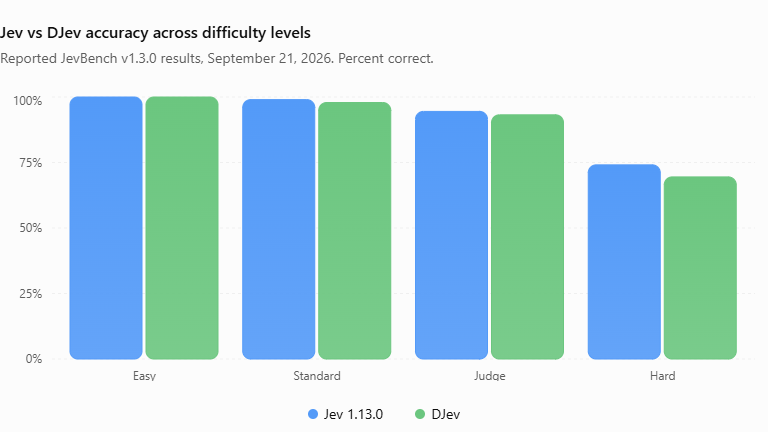
Accuracy measures whether a model selects the correct answer. Calibration evaluates whether its estimated probabilities correspond to how often those predictions are correct.
JevBench v1.5.6 reported the following results:
Source: Jev vs DJev, JevBench v1.5.6 comparison
The standard DJev configuration scored below Jev on calibration (80.4 vs 88.0), while DJev's separate thinking configuration scored higher on both intelligence and calibration (77.3 vs 72.0; 95.7 vs 88.0). However, the thinking configuration carried substantially greater computational cost and placed only #62 in v1.5.6 with a 17.4 composite score due to its poor cost rating.
This distinction matters for automated workflows. Maisa's own documentation describes the standard DJev configuration as "experimental and uncalibrated," meaning its probability estimates may not correspond to actual correctness rates. A model can frequently choose the correct answer while producing probability estimates that are unsuitable for direct approval or escalation thresholds.
Before using either model in production, teams should evaluate calibration against their own labeled data, establish appropriate confidence thresholds, and route uncertain decisions for additional review. Only DJev's thinking variant demonstrates production-grade calibration, but at significantly higher inference cost.
Developers can access DJev through Maisa's hosted research-preview API or run a separate open-source implementation on their own infrastructure. The choice affects API access, operating costs, infrastructure management, and integration requirements.
DJev's hosted API requires an invitation and uses Bearer API-key authentication. Applications submit structured decisions through POST https://api.djev.dev/v1/request.
The published pricing is $0.035 per million billed input tokens (announced during free preview), with output tokens free when prepaid billing is enabled. During JevBench v1.2 benchmarking, nothing was actually charged under this preview tier. The documentation states that prepaid billing is being prepared, so developers should check its current availability before planning production usage.
DJev calculates billable input usage from actual model reads, including repeated context, internal prompt formatting, and image-expanded tokens. Consequently, the final token count can exceed the original text input.
Source: DJev Official API Documentation, Limits
The open-source djev-dev implementation allows developers to operate DJev's structured inference system on infrastructure they control.
Its documented reference environment includes:
Licensing: Apache-2.0 for the implementation code; separate upstream terms for model weights. The repository NOTICE file credits Google DeepMind for DiffusionGemma but states "No affiliation or endorsement is implied."
The B200 is the documented reference hardware, not a proven minimum requirement for every deployment. However, this is a serious machine-class GPU, and teams should expect substantial infrastructure investment for self-hosted deployments.
Unlike the managed API, self-hosting places infrastructure security, GPU provisioning, service availability, and maintenance under the development team's responsibility. The open implementation also does not include the hosted service's full account-management and billing infrastructure.
Source: DJev Open Implementation, GitHub.
Jev and DJev share the Choice, Score, and Noul decision concepts, but their APIs should not be assumed to be directly interchangeable.
Applications migrating from Jev should:
DJev supports recoverable operations using saved request identifiers and exact request bytes. This helps applications retrieve accepted results following connection interruptions without unnecessarily repeating successful work.
A successful migration therefore requires both interface compatibility and acceptable decision behavior on the intended workload.
Source: DJev Official API Reference, Request and Response
DJev supports structured decisions involving text, JSON, and images. Its bounded decision capabilities can be applied to visual matching, evidence evaluation, retrieval, agent orchestration, and business automation.
An ecommerce platform could use DJev to compare customer-uploaded photographs with catalog images and select the closest match from predefined options.
Potential applications include:
This is particularly useful when product characteristics are difficult to describe accurately in text.
AI applications sometimes need to evaluate whether a generated statement is supported by the information provided.
DJev could assess claims against supplied evidence using predefined verification criteria.
For example, an invoice-processing assistant could evaluate whether an extracted payment amount matches the amount visible in the source document.
Possible decision outcomes include:
These outcomes would need to be defined in the application's decision schema. DJev's judgment is not a substitute for deterministic validation where exact matching is possible.
Retrieval-augmented generation (RAG) systems often retrieve passages with varying degrees of relevance to a user's question.
DJev could evaluate candidate passages against a predefined relevance rubric and return structured scores that the application uses for ranking.
A possible workflow includes:
Unlike claim verification, which evaluates a completed statement against evidence, this use case focuses on selecting useful information before answer generation.
AI applications often rely on specialized agents or tools to handle different requests.
DJev could classify an incoming request and select a predefined destination, such as:
The selected result informs the application's next step, while application code remains responsible for permissions and tool execution.
For a broader explanation of these decision patterns, see Jev AI use cases, including agent routing, tool selection, and workflow automation.
Business workflows frequently need to classify incoming information or evaluate whether it satisfies predefined criteria.
DJev's bounded decision types could support questions such as:
For example, a procurement workflow could classify an incoming supplier request and assign it a review priority before passing it to the appropriate team.
These are potential applications of DJev's decision primitives rather than independently benchmarked business workflows.
DJev offers a different approach to structured AI inference, but adopting it introduces practical constraints beyond model performance. These five considerations are particularly relevant when evaluating DJev for production applications.
DJev's Maisa-powered API is offered as an invitation-based research preview. Developers should not assume that production service-level agreements, dedicated support, or guaranteed capacity are available.
The documented capacity_paused response also means applications must handle periods when the hosted service cannot process requests.
For business-critical workflows, teams should confirm service commitments and implement appropriate fallback behavior before deployment.
DJev's open implementation requires modifications to vLLM rather than running entirely on an unmodified inference server.
This creates potential compatibility challenges when upgrading vLLM, CUDA, GPU drivers, or the underlying model checkpoint. Teams adopting the open runtime should test upgrades in a separate environment and maintain a reproducible deployment configuration.
DJev accepts visual inputs, but images contribute to the model's processed input rather than being treated as cost-free attachments.
For applications that evaluate multiple images or repeatedly analyze visual inputs, billable input usage may increase. Developers should estimate expenses using actual reported token consumption and realistic request patterns rather than calculating costs from text length alone.
DJev can evaluate multiple independent questions in one request, but the result of one question cannot automatically become the input to another question within that same request.
This makes external orchestration necessary for workflows involving dependent decisions, conditional branches, or multiple processing stages.
DJev evaluates the information supplied in a request. It does not independently retrieve current information, execute external tools, or verify the authenticity of a source.
Applications therefore need separate retrieval, validation, authorization, and execution components when using DJev in larger AI agent workflows.
When choosing between jev vs djev for your production architecture, the right choice comes down to your primary data format and the complexity of your decision logic. Both models excel at structured decision-making, but they serve fundamentally different application requirements.
To determine your final choice in the jev vs djev debate, evaluate these three core operational constraints:
Ultimately, balancing your raw input constraints against your backend integration preferences will guide you to the correct model for your automation system.
Yes. DJev uses Google's DiffusionGemma as its foundation for diffusion-based decision inference. Its open implementation uses a modified vLLM runtime to extract structured probabilities from predefined answer options.
DJev supports native image inputs, visual comparisons, and decisions on sampled camera frames. However, it does not provide built-in temporal memory or continuous video understanding.
DJev recorded lower latency in some published JevBench comparisons. However, response times depend on model versions, hardware, input complexity, and deployment conditions, so neither is universally faster.
DJev has an Apache-2.0-licensed open implementation, although its underlying model weights have separate licensing terms. The Maisa-powered hosted API is a separate service with published usage-based pricing.
Potentially. Both support Choice, Score, and Noul decisions, but API compatibility is not guaranteed. Developers should validate request formats, decision outputs, and confidence thresholds before migrating.
