
Are you using increasingly powerful AI coding tools but still struggling to find the right balance between performance, control, privacy, and cost?
That challenge is becoming more important as AI moves deeper into software development.
A 2026 ACM study of 2,989 developers found that while 86% were satisfied or very satisfied with AI coding assistants, around 60% reported saving less than one hour per week, showing that access to a capable model does not automatically translate into meaningful productivity gains (Source).
Reliability also remains a concern.
A 2025 peer-reviewed IEEE systematic review of 58 studies found that only 10.34% evaluated security and robustness, while hallucinations, security vulnerabilities, and limited generalizability remained recurring challenges in LLM-based code generation (Source).
That makes model selection critical. The best open-weight models for coding in 2026 are not defined by benchmark scores alone; the right choice depends on coding workload, agentic capability, context requirements, deployment environment, privacy, licensing, and total inference cost.
Open-weight models are AI models whose trained parameters, or “weights,” are available for users to access and deploy. These weights contain the learned numerical relationships that allow the model to understand prompts and generate outputs.
For developers and engineering teams, open-weight models can provide more control over how AI is used in coding workflows. They can be used to:
This makes them useful for organizations working with proprietary codebases, regulated data, or strict data-residency requirements.
However, access to the weights does not mean every part of the model is open. Training data, training code, data-processing pipelines, or development methods may still remain private, and the model license may impose restrictions on commercial use, modification, redistribution, or fine-tuning.
So, open-weight describes access to the trained model parameters, not necessarily full access to everything used to build the model, and it does not guarantee unrestricted deployment rights.
The terms open-source, open-weight, and closed-source describe how much access users have to an AI model and the resources behind it.
The key distinction is how much of the model ecosystem is accessible. Open-source models generally provide the broadest transparency, open-weight models expose the trained parameters but not necessarily the full development stack, and closed-source models keep the underlying model private.
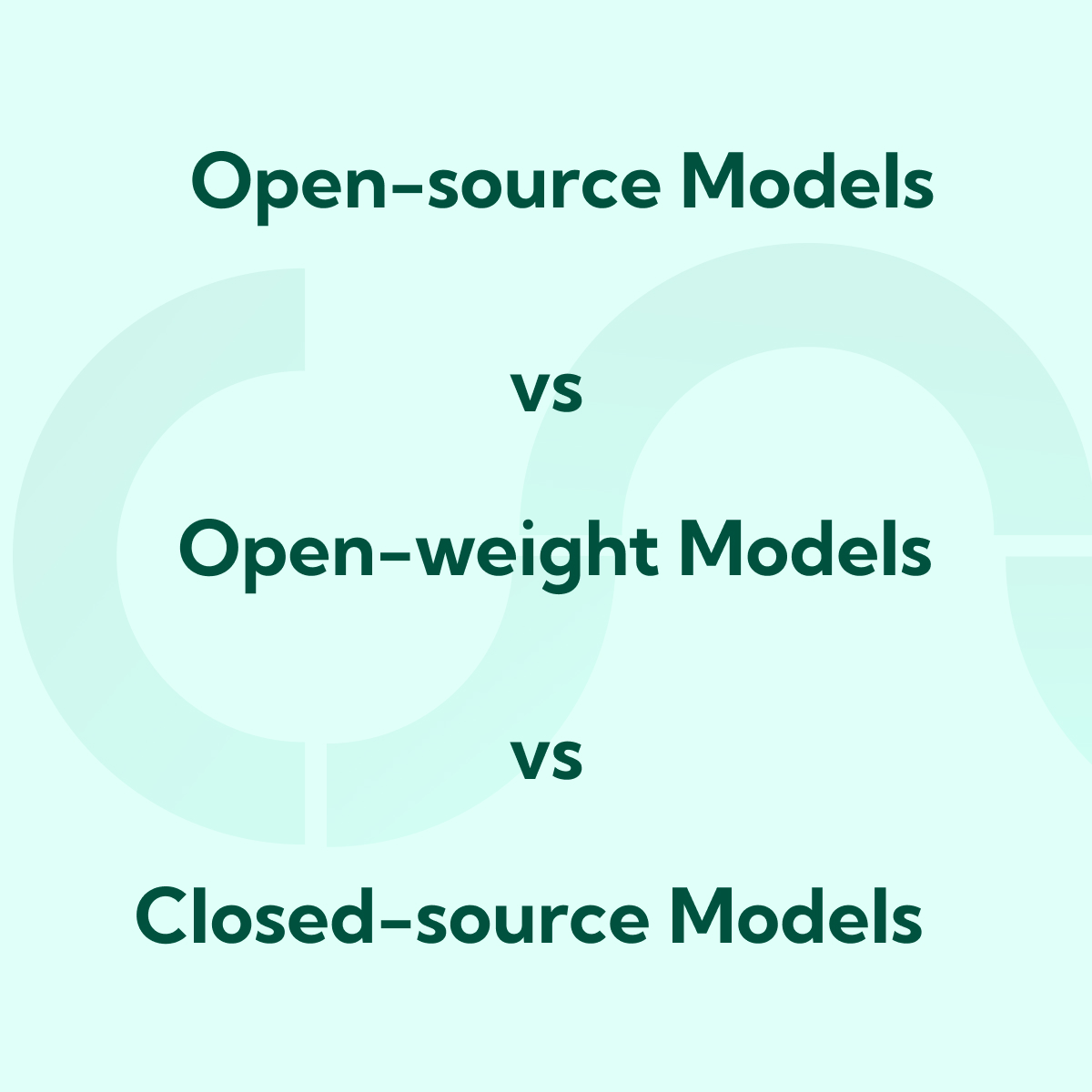
For coding teams, these differences directly affect deployment flexibility, customization, data control, and commercial usage rights.
The leading open-weight coding models differ most in agentic performance, multimodal capability, context length, deployment flexibility, and licensing. The table below gives a quick side-by-side view before the detailed comparisons.
GLM-5.2 is designed for long-horizon software engineering across large codebases. Its 1M-token context window and 128K output capacity help coding agents retain architecture, dependencies, tests, and implementation details across extended tasks.
Key capabilities include:
GLM-5.2 is available under the MIT license and supports self-hosting through frameworks such as vLLM and SGLang.
Limitation: Its large size demands substantial compute for self-hosted deployment.
Best for: autonomous coding agents and long-running engineering workflows.
DeepSeek-V4-Pro is designed for complex coding, debugging, and agentic software-engineering tasks with a 1M-token context window.
Key capabilities include:
It supports both thinking and non-thinking modes, along with tool calling for agent workflows.
Limitation: Self-hosting still requires substantial compute because of the model’s scale.
Best for: teams that need strong coding and reasoning performance with better inference efficiency than many large frontier models.
Also read Choose the Right AI Model for Reliable WorkflowsChoose the Right AI Model
MiniMax M3 is built for coding workflows that combine long context with visual inputs. It supports a 1M-token context window and can process text, images, and video.
Key capabilities include:
Its MiniMax Sparse Attention architecture is designed to improve inference efficiency at long context lengths, making it suitable for production-scale workloads.
Limitation: Large-scale self-hosting still requires substantial compute resources.
Best for: production coding workflows that need multimodal input and long-context processing.
Note: MiniMax M3’s weights are available, but the model is released under MiniMax’s own community license rather than a standard permissive open-source license. Teams should review the license terms for commercial use, modification, and redistribution before production deployment.
Kimi K2.6 is designed for coding workflows that combine multimodal input with agent orchestration. It supports a 256K-token context window and can process text, images, and video.
Key capabilities include:
K2.6 also supports thinking and non-thinking modes, tool calling, and automatic context caching.
Limitation: Its 256K context window is smaller than the 1M-token capacity offered by some competing models.
Best for: visual coding and multi-agent software-development workflows.
Qwen3-Coder-Next is a coding-focused open-weight model with 80B total parameters and only 3B active per token, making its MoE architecture more efficient for inference than its full parameter count suggests.
Also read AI Image Generation Models
Key capabilities include:
Its sparse MoE and hybrid-attention design also improves throughput and long-context efficiency.
Limitation: Practical local deployment still requires capable hardware because the full model remains large.
Best for: local and self-hosted coding agents.
Llama 4 Maverick is a multimodal MoE model with 400B total parameters, 17B active parameters, and a 1M-token context window. It can work with text and images while generating code, making it suitable for development tasks that need both programming and visual context.
Key capabilities include:
It is released under the Llama 4 Community License and supports deployment through frameworks such as vLLM and SGLang.
Limitation: It is not a coding-specialized model, so dedicated coding models may perform better on advanced software-engineering tasks.
Best for: coding workflows that also require image understanding and broad multimodal reasoning.
Running open-weight models locally depends mainly on model size, available GPU memory, system RAM, and the inference framework you use.
A practical rule of thumb:
For deployment, tools such as Ollama and LM Studio simplify local inference, while vLLM and SGLang are better suited to larger production workloads.
Quantization can significantly reduce memory requirements by storing model weights at lower precision, making larger models more practical on limited hardware. However, actual memory usage still depends on context length, caching, batch size, and serving configuration.
We compared each model using both coding benchmarks and practical deployment criteria, rather than relying on a single score.
Also read Small Language Models
We considered benchmarks that measure different software-development capabilities:
We also evaluated:
Benchmark scores should still be interpreted cautiously because results can vary with the agent scaffold, prompts, available tools, retry limits, and evaluation setup.
The best open-weight coding model depends on the workflow you need to support.
For long-running agentic engineering, GLM-5.2 is the strongest fit in this list. If local deployment and infrastructure control matter more, Qwen3-Coder-Next 80B is the more practical choice. For workflows that combine code with images, interfaces, or other visual inputs, MiniMax M3 and Kimi K2.6 are better suited.
The key is to choose based on real development needs and deployment constraints, not leaderboard position alone. A model that fits your infrastructure, privacy requirements, and task complexity will usually be more useful than one that simply posts the highest benchmark score.
An open-weight model makes its trained parameters available for users to access, deploy, or adapt. However, its training data, source code, or full development process may still remain private.
Many open-weight models can be downloaded without a model-access fee, but usage still depends on the license. Running them also creates infrastructure costs for GPUs, storage, hosting, and inference.
Leading options in 2026 include GLM-5.2, DeepSeek-V4-Pro, MiniMax M3, Kimi K2.6, Qwen3-Coder-Next 80B, and Llama 4 Maverick. The best choice depends on the coding workload and deployment requirements.
Yes, if the model’s license permits commercial use and your infrastructure can support it. Teams should also evaluate security, reliability, inference cost, and data-handling requirements before deployment.
GLM-5.2, DeepSeek-V4-Pro, MiniMax M3, and Llama 4 Maverick support context windows of up to 1 million tokens, making them suitable for large repositories and long development sessions.
Open-weight models are increasingly competitive for coding, reasoning, and agentic workflows, but performance varies by task. Proprietary models may still lead in some scenarios, while open-weight models offer greater deployment and customization control.
